UNEF
Obituary
Indar Jit Rikhye
Jun 7th 2007
From The Economist print edition
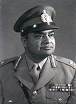
Major-General Indar Jit Rikhye, an Indian peacekeeper, died on May 21st, aged 86
AP
SUCH a meeting was not easily forgotten. The small, bald, wiry man, dressed in a
dhoti and leaning on a staff, peered through his spectacles at the 17-year-old
schoolboy, who was too abashed to speak. “This silly boy wants to go into the
army,” his father was saying. Mahatma Gandhi did not miss a beat. “But that is
good!” he cried. “We need good, educated young officers in the army of free
India!”
Indar Jit Rikhye did not get the lecture on peace he expected. That was as well,
for with his young head full of military parades, war novels and tales of his
family connections with Maharajah Ranjit Singh, “the Lion of Punjab”, he was not
inclined to listen. But Gandhi was wise, and possibly foresaw that Indar Jit's
life as a soldier was in fact to be all about peace.
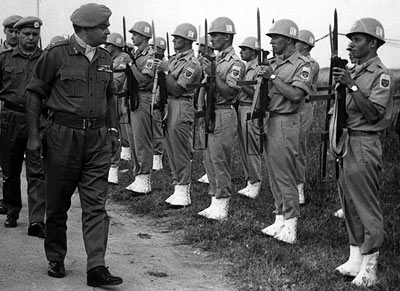
His most famous test came in Gaza in 1967, just before the six-day war between
Egypt and Israel. General Rikhye, then commander of the United Nations Emergency
Force, was asked by the Egyptians to withdraw from the buffer zone where, for a
while, UN peacekeepers had been preserving calm.Unflustered, he played for time;
and when Israel launched its attack on Egypt, the peacekeepers were caught in
the middle. Several were killed; the HQ was destroyed by shelling; the tyres
were shot out on their military jeeps, and only by bumping on the hubs could
they flee to the beach at Gaza to radio for rescue. “We are not fighting anybody”,
General Rikhye told New York, via Cyprus, “but we are under fire.” A
peacekeeper's life.
He knew the Middle East; his career as a peacekeeper had begun there in 1956,
sent out by Jawaharlal Nehru in a flush of enthusiasm to prove the neutral
credentials of newly independent India. This was the UN's first armed
peacekeeping force, stationed along the Suez Canal. General Rikhye, by then a
soldier of much experience in both the British and Indian armies, thought it an
odd outfit, combining all levels of expertise and none, and with national
liaison officers reporting to their own governments. When he was made chief of
staff the next year he shook things up, and everyone reported to him.
Other problems were less tractable. Chief among them was the Middle East itself.
It was not the most difficult of his peacekeeping assignments: that, he decided,
was probably Congo, where the UN force in 1960 was forced to recognise a de
facto authority that was both illegitimate and murderous. But the Middle East
was a place where ancient grievances marred all hope of peace. The general did
not believe he would ever see it there.
Peacekeepers were even resented for doing their job. General
Rikhye, a man not easily rattled, was shocked to find his UN plane fired on, and
almost forced down, by Israeli jets in 1967. And in 1982, with UN troops
installed in another buffer zone in Lebanon after the Israeli invasion, he was
outraged to find them hemmed in by Israeli and PLO road-blocks on each side,
“like the salami in a sandwich”.
Any soldier—as he reflected in “The Thin Blue Line”, his recommendations on
peacekeeping, in 1974—would find it emotionally difficult to be fired on and not
fire back. He found it hard himself. But peacekeeping was not about force; it
was about providing time, with the consent of the disputing parties, for
diplomacy to work. This refereeing job required different skills: quiet
reasoning, non-alignment to the point of total detachment, tact and “the
patience of a Job.” It did not need “the self-loading rifle”. The UN,
politically divided and a bureaucratic tangle, was not always ideal for the job.
But General Rikhye was sure it was all the world had.
After long service there—in Indonesia, Cuba and Yemen, and as military adviser
to two secretary-generals —he set up the International Peace Academy in New
York. Military officers and diplomats in mid-career were sent there to sort out
simulated conflicts, from the first explosion of violence to the passing of
resolutions in the Security Council and the imposition of a ceasefire. Most
important, in General Rikhye's view, peacekeepers bound for particular trouble
spots were instructed in the history and emotions behind the troubles, so that
they would understand.
Hobnobbing with Zia
He had his own reasons for becoming one of the world's best
peacekeepers. He was born in Lahore, in the Punjab, and joined the undivided
Indian army in 1941 in the Punjabi Muslim squadron of the 6th Lancers. Although
a Hindu himself, he liked being with Muslims. When, on partition in 1947, he was
asked to declare which state he wished to serve, he chose Pakistan. But as a
Hindu, he was repatriated to India.
He went back once to Lahore in 1982 as the guest of Zia ul-Haq. Zia, then
president of Pakistan, had once been his subordinate; General Rikhye had got him
his permanent commission as a lieutenant over the suspicions of the British. At
a time of poisonous relations between India and Pakistan, the two men met as old
friends.

In his last years, living contentedly in America, General
Rikhye would often wish aloud that Pakistan and India could bridge their
differences and combine their armies. Together, they could make a huge
contribution to keeping the peace of the world. Indeed, it was perhaps just such
an army that Gandhi had
imagined and, with a smile, had committed him to.